Showing posts with label Beer Tourism. Show all posts

Monday, June 24, 2013

La Bodega De Chema: How To Make Costa Rica Craft Beer

I have pointed out before that the beer in Costa Rica sucks.  What are the solutions to this problem?

You can be a typical expat and complain about it.  You can switch to liquor or wine (always a good solution.)  You can pay expensive shipping fees and risk broken bottles in beer-soaked cartons.  Or you can make your own beer.

This Is Not Beer
If you are living in Costa Rica and want to make something new for your pint glass, La Bodega de Chema is the place to try your hand at homebrewing.  Chema is a brillant Costa Rican who studied engineering in Rochester, New York.  While living there he fell in love with American craft beer.  When he returned to Costa Rica, he realized he was stuck drinking the same old, boring Imperial and Pilsen again (boo!) and had to find a way to bring tasty craft beer home.

The result of his efforts is La Bodega De Chema.  It isn't a bar or a restaurant, but a beer education facility.  In this little room in a quiet part of San Jose, you can sample Costa Rican and foreign craft beer, buy homebrewing products and materials, and enroll in one-day homebrewing classes taught by Chema and his brewing team.  Experienced brewers will be excited to see this course is taught using the all-grain method, and not with malt extract (mainly because imported extract is really expensive in Costa Rica.)


I was too late to enroll in his inaugural brewing class in May of 2012, but I did get a place in the second class in the second week of June, 2012.  A 5 hour class costs 20,000 colones, or approximately 40 dollars.  This price not only includes the hands-on brewing class, but also a brewing instruction manual, several beer tastings, a discount on La Bodega's products and two bottles of your own beer when it is ready 2 weeks later.  You also get to study your Spanish for 5 straight hours (what, don't you speak Spanish??)

I was the only gringo in the course that day.  My Spanish is far from perfect, but making beer doesn't require much listening.  Just watch and learn.  I will break from my usual long ranting, sarcastic style and present this course in simple, step-by-step pictures and videos.

All you need to make beer are grains, hops, yeast and water.  Start by grinding the grains.  You can do this with a plastic bag and a rubber hammer, or use this convenient grist:


 Now you have malt.  You have to soak the malt in hot water to start fermentation, which produces the most important part of the beer, the alcohol!!  We did this in a cooler fitted with a complex, handmade plastic sieve at the bottom.  It helps to have technical skills (there's a reason many engineers are homebrewers.)


It takes around an hour for fermentation.  We used this time in the most productive way possible, by drinking beer!  We sampled Imperial, Costa Rica Craft Brewing's beer Libertas and Segua and Germany's Erdinger.


The result of the hot soaking malt is a boozy soup called wort.  You have to separate the liquid wort from the grains.  Chema sends the used grains to local farms for cow feed.  How pleasantly organic.


While we are separating the liquid wort from the grains, we have to constantly take samples.  We check the samples for alcoholic content with a little glass stick called a hydrometer.  If it's too strong, you will have to water it down.  As a typical alcoholic I don't mind a 10% alcohol beer, but for the mass market 4% is a little easier to handle.


This wort has alcohol and looks like beer, but it still doesn't smell like beer.  We have to boil the wort with hops to get that lovely beer smell.  What time, what type and how much hops you add all depend on the style of beer.  I'll save that part for the beer geeks to argue about.  Most Costa Ricans just aren't ready to drink Quintupletripledipple-Dry-Hopped, Barrel-Rolled, Sour Imperial Monarch Butterfly, Double-Ds IPAs...or whatever ridiculous, over-hyped shit they're making in the United States now.


While the wort is boiling, several other things are happening.  Chema's last class prepared some hopped wort which has been fermenting for the past few weeks.  We have to add sugar to this prepared wort and mix it.  This starts carbonation, which gives the beer that happy head we love so much.  We used natural sugar; Costa Rica still doesn't have a lot of those fancy brewing products yet.


We were also sanitizing bottles while the wort was boiling.  These sanitized bottles will now store the finished, carbonating product.  To properly ferment, the bottles need to be sealed airtight with caps.  Bottling the beer is probably the most physically strenuous process in homebrewing.  Don't expect it to burn off your beer belly though.


We have added all the hops and the wort is finished cooking.  Now comes the complicated part of cooling off the mix rapidly without infecting it.  This is another part where being an engineer helps.  It's usually enough to cool off the pot in a cold water bath, but Chema constructed a nifty copper tube device connected to a water hose.  It runs cold water through the beer to cool it off even quicker.  This is the part where my technical skills would fail...


Finally we have beer.  Well, not yet.  We still have to wait 2 more weeks for the bottled product to finish fermenting.  If you've been observant, you see we're actually drinking the beer made from the previous class.  Either way the end result is the same.  I have two new bottles of Cahuita Pale Ale to drink.  It's not Imperial or Pilsen, Gracias a Dios!


I am aware that this is not a complete course on brewing beer, so please beer geeks refrain from writing comments about details I've forgotten (e.g. temperatures, IBUs)  I am an alcoholic traveler, not a brewer.


Thursday, April 4, 2013

My Midwest Paradise: Missouri Wine Country (Plus Craft Beer)

I was back in St. Louis for the holidays.  The robbery in Costa Rica and the fight in Castle Tam Hostel had happened two days ago but they were a thousand miles away.  For a short time I could forget them.  I'm going to the place where I always go to forget worries when I go home: Missouri Wine Country.

Ever since I turned 21 my family and I, plus family friends, always try to make it here once a year to share wine, craft beer and fine cigars.  Even before I was old enough to drink or smoke (legally) I became familiar with this area from its various state parks that I hiked as a youth.

 Before I continue, I will make it clear that Missouri Wine Country is actually two regions: the historically Germanic area located on the Missouri River Valley to the west of St. Louis, and the more French Route du Vin located south of St. Louis near Sainte Genevieve.   Both regions are full of wide rolling hills and valleys, rocky cliffs that dive into babbling creeks and lush hardwood forests that look their finest in autumn when the leaves burst into fireworks of color.  The beautiful scenery not only has merited these regions designations as Missouri state parks, but the rolling hills are also ideal terrain for cultivating wine grapes.  Many German immigrants of the western Rhineland and French immigrants from the neighboring border regions settled here because it reminded them of home.

The Missouri River Valley west of St. Louis has two specific wine regions: the Weinstrasse, located on Old Highway 94 north of the Missouri River, and the longer Hermann Wine Trail which winds south of the river along Old Highway 100.  There're both easy trips for anyone unfamiliar with the area since the wineries are practically in a row on the roads and well marked.  The Hermann Wine Trail has seven principal wineries and they majority of them are located in Hermann within walking distance of each other.  The Weinstrasse has only four wineries and is more spread out, but it is on more scenic, hilly terrain.

 These are wonderful places which I will talk about more at another time.  This year I went to the bootheel of Missouri for the Route de Vin, a good hour drive south of St. Louis on Highway 55 to Exit 150 (Ste. Genevieve.)  Here you can spend the morning burning calories hiking on the white pine-covered trails of Hawn State Park; and spend the afternoon gaining those calories back with bottles of wine at the wineries.

Hawn State Park is located approximately in the middle of the wine trail.  The park encompasses several old growth forests of "Whispering Pines," so called for the hushing sound they make whenever a strong wind blows through them.  There are several trails that wander through these pine forests; two short 4 miles trails, one of 6 miles and a long rolling 10 mile trail.  In the interest of time we chose the 6 mile trail so that we could have more time for drinking, but still work up a sweat.  Somewhere around the 3rd mile we started climbing a hill and at the top found ourselves in the middle of the largest of the white pine forests.  In the silence of winter the whispering pines practically scream.


 After the pine forest, we continued over the hill to a series of rocky cliffs overlooking a wide valley.  Somewhere below us was Pickle Creek, a babbling stream that meanders through the park.  The 6 mile trail goes in a loop that crosses the creek twice.  A mile after looking over the big valley we came to some more sharp cliffs that dove directly into the creek before the trail finished.  The look down gave me just enough vertigo to be happy we were almost finished and ready to begin drinking a strong red Norton in the firelight warmth of a winery.


Our hike lasted into the afternoon, so we only visited two of the wineries that day.  Why would you want to rush wine anyway?  From Hawn State Park it's about 15 minutes on Highway WW to the nearest vineyard, the large Chaumette Winery.  Once at the bar inside, our server gave us their wine list and asked us to select 5 tastings.  I've never been to California's famous Napa Valley, but I imagine it would shock me to have to pay for every tasting.  Most Missouri wineries have totally free tastings from 3 up to 7 glasses depending on the size of the place.

For this reason we skipped the nearby Crown Valley Winery in favor of going to the smaller Charleville Winery.  Crown Valley is a massive, impressive place modeled after the California wineries, with nationally award-winning wines to match; but it charges for tastings and it's frequently too busy.

Our group of drinkers has gravitated to quiet, little Charleville because it has better scenery, a more family-owned feel and (most importantly) good craft beer.  Although other Missouri wineries have recently started homebrewing in an attempt to follow the burgeoning craft beer movement, Charleville started before it got big and their experience shows.  Driving to the end of Highway WW and winding up the rocky road in 3rd gear to this isolated spot is well worth the extra effort.

This was the last stop for the day.  There was no rush.  We tasted a few wines and followed them with a beer sampler.  Here you can find an IPA, their big Tornado Alley red ale, a Belgian ale, several stouts and some creative seasonal brews, including the Box Of Chocolate, a special Belgian Ale brewed with chocolate.  We bought pints of the beer that best suited us then went to the porch to pass the afternoon by the fire-pit smoking cigars and shooting the shit.  For me, no trip to Missouri is complete without stopping here.


Tuesday, March 19, 2013

There Is Costa Rican Craft Beer: Costa Rica Craft Brewing in Cartago

What do I have to do to get a good craft beer in Costa Rica?


I've spent the past few years becoming a good beer geek in the United States.  My 2 years in Europe was fine for drinking good beer, but Costa Rica put that to a stand still.  As anyone who has been in Costa Rica for more than one day knows, it's pretty much Imperial or Pilsen everyday.  One of Costa Rica's brews, Rock Ice, even got on a list of "Worst Beers On Earth."  It looks pretty desperate.


What I found was "Costa Rica Craft Brewing" in Cartago.  This is possibly the most awkward, obvious name for a microbrewery in existence, but it serves a purpose.  The name clearly communicates to any gringo traveler or American expat beer nerd that this is not just another yellow, watery, mass-produced Central American beer.  To avoid typing out this ungainly name, I shall now refer to the brewery by their initials, CRCB.

CRCB's flagship brews are Libertas, a light, fruity "tropical ale," and Segua, a sweet, hoppy red ale.  Libertas caters more to the local Costa Rica market, which typically finds big beers like IPAs and Russian Imperial Porters to be too strong.  Segua is for American Hopheads who need a fix in Costa Rica because they can't find any IPAs.  CRCB also has seasonal beers which show up on tap every 3 or 4 months around the country.  You can find draft and bottle locations at their website: http://beer.cr/   Additionally there are specialty beers which they only have at the brewery itself.

My goal on a rainy Saturday in October was to locate the CRCB brewery and buy a few dozen bottles to sell (illegally) at the hostel I managed.  If you don't have a car, take a bus from San Jose to central Cartago.  After searching for a local bus to the "Tejar de El Guarco" neighborhood, you either walk a mile or take a taxi.  The specific address is: "800 mts oeste de RITEVE El Tejar de El Guarco" but as I've discussed in a previous post, directions in Costa Rica are meaningless.  Just call them first: (506) 2573-3724.

I went with two lovely Quebecois girls from the hostel who were in Costa Rica representing their clothing company, Poze, for a 'fashion bicycle tour.'  I'm still not sure what this means, but I got to take lots of pictures of two good-looking, French-Canadian girls.  Oh-la-la, eh?

Our first bus dropped us off in downtown Cartago, so we spent some time checking out the historic ruins of Santiago Apostal Parish.  Technically they aren't ruins, but were in mid-construction in 1910 when an earthquake struck.  The Costa Ricans figured - eh, Pura Vida - we'll get around to finishing them, and 100 years later...  The earthquake is the source of much myth; one 'telenovela-style' story says the priest who helped found the Santiago Parish fell in love with his non-clerical brother's wife.  God sent the earthquake as his punishment for being unfaithful.


After (literally) jumping around on the ruins for awhile, we found the bus to the rural Tejar neighborhood where CRCB is located.  With rain impeding our progress, we opted for a taxi down the country road and actually drove by the brewery once before finding it.  I don't know about the Quebecois girls' sentiments, but I felt as if I had arrived at an oasis in the middle of a beer desert.

CRCB, however is not a desert.  It is officially the coldest place in Costa Rica due to sub-zero refrigeration used in the building to maintain stable beer fermentation temperatures.  We were given a Spanglish tour by friendly Juan and one of the brewers, Stefan, a young half-German, half-Tico who favored the German side.  After showing the us the tanks, grains and bottle-works, we finished the short tour with the most important part - tasting.


Cartago is surprisingly more insanely, religiously-conservative than most of Costa Rica.  What this means for CRCB is that the provincial law prohibits you from opening bottles of beer in the brewery!  You are allowed to drink three tap samples, but you can't actually enjoy a full beer pint there...unreal.  The nice part of the tasting was getting to try a Blueberry Stout which was only available at the brewery.  When I realized I couldn't drink bottles or pints there, I attempted to abuse my sampling privileges then quickly got out of there with a 24 case of Libertas and Segua I had purchased for $50.


We briefly stopped at the Cartago City Market so the girls could go shopping for random, handicraft crap.  I wandered aimlessly around the market with my box of beer, listening to the Cartago rain fall, and savoring the moment I would return to the hostel and open the first hoppy Segua bottle.


Friday, March 8, 2013

DULTfest Regensburg: The Other German Beer Festival

Oktoberfest, Munich

Yes, we've all heard of it and everyone wants to go.  That's the problem.  Everyone - and I mean everyone - goes.  Unless you go alone and arrive early in the morning, expect to walk around for 2 or 3 hours until a bench opens up.  I only found a spot at night by virtue of wearing my "Baracktoberfest" Schlafly Beer t-shirt.  Some Americans recognized Obama's smiling presidential face on my shirt and invited me to squeeze in on the bench.

DULTfest, Regensburg


Have you heard of it?  If you don't want to fight crowds and wait hours for a delicious German beer, there are hundreds of other smaller Beerfests around the country.  By sheer chance my hitchhiking trip through Regensburg in August coincided with DULTfest.  I randomly chose Regensburg, but it is a scenic UNESCO World Heritage Site which is well worth passing through for more than just the beer festival.  This is truly Bavaria.


Here's something you never see at Oktoberfest - an empty beer tent.  I found Brook Lane Hostel and spent the morning recovering from my nightmare hitchhiking trip from Austria.  After a brief rest I set off for DULTfest around 2pm.  The pictures are courtesy of Romy, a nice Bavarian girl I met at the hostel whose photography skills are far better than mine.  Thanks to her talent, I look almost professional even with a comically large beer and a massive wiener in my hand (*snicker*).


I was sober at the time this picture was taken.  I only spent a brief time at the festival sampling some local beers and Bavarian food before returning to the hostel to sleep some more.  When I awoke Romy was gone, but a few new guests had arrived.  A wandering Czech who was working in Germany and a young Irish business student became my drinking buddies for the evening.

The night progressed as one would expect at a beer festival.  We visited the 6 different tents and settled on the largest based on the fact it was hosting a curious sport where participates had to climb up the tent's tallest central pole in order to win...you guessed it, beer.  We placed bets on the pole climbers, and after drinking several liters and bullshiting travel stories, we returned to the hostel considerably drunker than before.  Regensburg was a brief, but perfect way to end my Eurotrip 2011.


Tuesday, November 13, 2012

Serbia's Belgrade Beer Festival

The Belgrade Beer Festival is not a beer festival.

That's what every beer geek back in the USA would say.  Out of the 20 or so beers available at the festival, there's nothing that would excite any major beer tourist.  Unfortunately, once you go east of Germany and the Czech Republic all the European beers start tasting the same.  If you want to be the first to say you've drank Jelen, Laskov, Niksicko, and some Irish-Style Serbian Craft Beer, then go for bragging rights.  They're still better than your average Central American beer, but nothing that will make beer geeks have beergasms.

Maps Are Irrelevant When You're This Drunk
You don't go to Belgrade for beer tasting...you go there to party.  The Belgrade Beer Festival is certainly a great place to party.  There's one massive stage that has live bands playing until the early hours of the morning.  Beer, alcohol and Serbian barbeque flow freely.  Beautiful Balkan girls will dance with you and crazy Balkans guys will challenge your foreign ass to out-drink them (good luck.)

Unlike Serbia's far more popular Exit Festival, the Belgrade Beer Festival still feels authentically Serbian. Most of the bands are national or former Yugoslavian rock acts that don't play outside of the Balkans. Meanwhile the Exit Festival attracts Europeans from all over to see international bands and DJs such as Guns N' Roses, Snoop Dogg, Eric Prydz, Artic Monkeys and David Guetta.

During 2 days at the Beer Festival, I didn't run into a single 'foreigner.'  Note the contrast.

Good Balkan Company
The big headliners for the 2011 Belgrade Beer Festivals were Riblja Čorba, Atomsko SkloništeKiki Lesendrić i Piloti and Marky Ramone's Blitzkrieg (yes, from The Ramones.)  And if anyone remembers the 1980s, Simple Minds also headlined.  One group which has never headlined, but which has played every festival dating back to the first in 2003 is the Orthodox Celts.  They are actually a national group, but true to their name they play traditional Irish folk music.  They fucking rock.

Are any of these groups ringing a bell??

From a local perspective, Riblja Čorba is probably the most famous of all the groups.  These old guys have managed to stay rocking since 1978 with most of the original band still intact.  I'm told their lyrics are quite funny and often political....if only I understood Serbian.


In addition to solid rock 'n' roll groups, the festival offers more typical traditional Serbian groups for people who are into the Gypsy Balkan sound made popular by Goran Bregovic, Emir Kusterica and the like.  As cool as that music is, some Serbians will tell you that Goran and Imir 'sold out.'  Go to this festival if you want to hear some undiscovered sounds...

My personal recommendation: buy a few liters of Jelen Pivo outside the festival where it's a lot cheaper and get drunk before you go in.  Most of the Serbians will be doing the same and -as with me- they might ask you, "Why the fuck you here, and not Exit Fest?!"  Then they will hand you a beer and say, "Ziveli!" You'll be in good company.  I certainly was.

I ♥ Balkan Girls 


Monday, August 8, 2011

Return To Europe: Vienna Waits For You


Passenger Service
------------------------------------------------------------------------
1 at 21.07.11 SAN JOSE (COSTA RICA) - SANTO DOMINGO
M DE 3235 09:30 - 14:20 (2:50h)
Economy Class
SANTO DOMINGO - FRANKFURT INT.
M DE 3235 15:20 - 06:40 (9:20h)
Economy Class
baggage incl.: 20 kg

They forgot to mention the 4 FUCKING HOUR delay in Santo Domingo.  I do not blame this on Condor Airlines, but rather on the Dominican Republic.  Their idea of efficiency makes Costa Rica look like Switzerland..

Generally flight delays do not bother me, since it gives me more time to drink beer in the airport bars.  German beer of course comes highly recommended worldwide.  For this particular reason a long wait in a German airport is quite exciting after 5 months of crappy, watery Costa Rican beer.


Unfortunately, this time the delay caused me to miss my morning German Rideshare from Frankfurt to Vienna, Austria.  I would have paid 35 Euros for the trip, but had to pay 100 plus Euros for a train trip.  This was already proving to be a horrible "budget backpacker" trip.  I finally arrived in at my Bulgarian friend Kosta Tonev's art studio sometime around 11pm.  Yes, he's a real artist who has had exhibitions all around the world.  I contemplated some of his recent works then passed out...
   
The next day I felt completely refreshed with the knowledge that I was back in Vienna after a year, and I would spend the day with Laura and Kosta, two of my friends from Romania and Bulgaria, respectively.  We meet in the weekend flea market around 4pm right before it closed on Saturday afternoon.  You can find many useful and useless things here for a fine price.  For example, here is a pimping fur coat for under 10 Euros:

Thank you fat guy in the back for making me look more attractive

After fooling around in the market, we got down to catching up on old times.  This was done in true Balkan style.  True Balkan conversation means sitting for hours at a cafe drinking coffee and smoking way too many cigarettes.  Since I was heading to Romania and Bulgaria, they were both very happy to share travel information with me about their countries.  Kosta also tried (unsuccessfully) to teach me how to roll a cigarette properly.  As you can see by his face, he was less than pleased with my final results...


Step 1.
Step 2.
Step...ah, dammit.

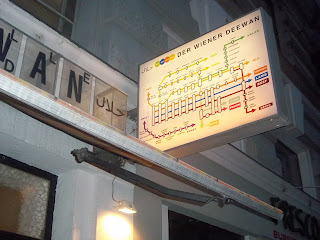
Der Wiener Deewan
After smoking a poorly rolled cigarette and sipping strong, black coffee, we strolled through the underground Metro on our way to find a place to eat.  Laura suggested Der Wiener Deewan Restaurant, a small, funky Pakistani buffet on the Liechtenstienstrasse.  Their eating concept was so crazy, Kosta and I did a double-take:

1. Eat as much as you want.

2. Pay as much as you want.

 WHAT? A customer can eat, eat, eat at the buffet and only pay 1 Euro cent.  This would seem like an easy way to make your restaurant go broke, but fortunately most Austrians aren't complete assholes and pay for good food and service when they have it (this would never work in Latin America.)  I settled on 5 Euros for 4 plates of food and still felt guilty.  Deewan also supports itself by charging for the drinks and merchandise.  This is why they've stayed open for almost 10 years now while serving up great Indian buffet-style food...plus you can eat laying down.


 After eating our fill we finished the night with a few beers across the street at Charlie P's Irish Pub.  I had a decent Munich beer and tried in vain again to roll a cigarette.  This one came out as good (or worse) than the first, but who cares when your with good friends.